O3DE 26.10 moves Editor to Qt 6, adds experimental Apple Silicon and removes PhysX 4
O3DE 26.10 has been released, with an Editor rebuilt on Qt 6.10.2, experimental native Mac ARM64 builds, GTAO and the final removal of PhysX 4. It also adds ROS 2 Lyrical Luth support and a cleaner, more standard core.
Digital Developer Desk, 10h ago, 3 min read
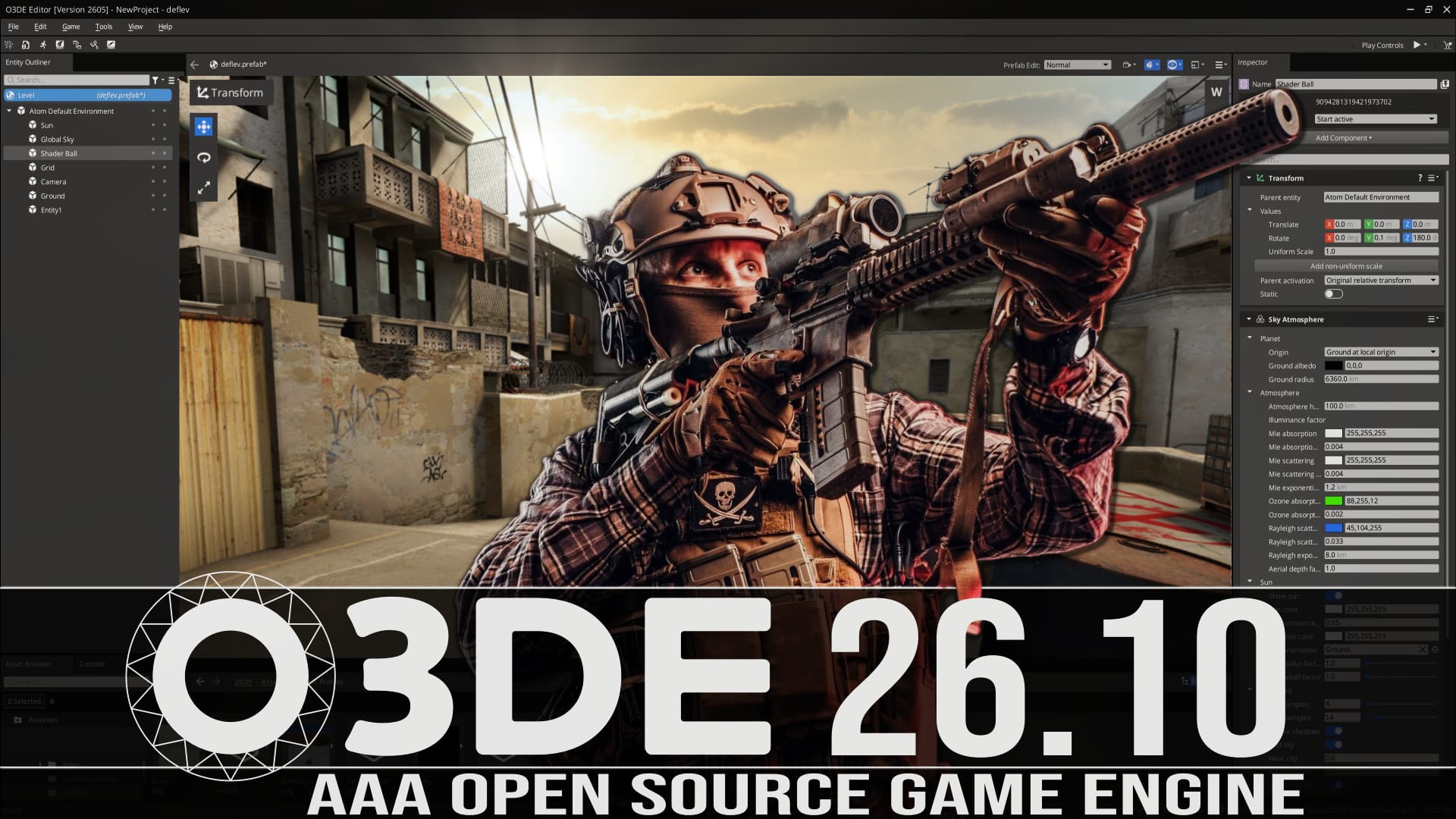
O3DE 26.10 has been released, according to GameFromScratch. The open source engine runs its tooling on Windows and Linux. The headline change is in the Editor: it and all its tools now build against standard Qt 6.10.2, replacing the Qt 5 build that is no longer maintained.
The Qt upgrade came with other Editor work. The Entity Inspector was reworked, keyboard shortcuts are now consistent across the Inspector, Outliner, Asset Editor and LyShine, and the Asset Editor gained undo. Crashes, docking issues and styling regressions found in testing were fixed. The Class Wizard can now target any project or Gem and any build target, and it generates basic, level, system and LyShine components as well as data assets. Project templates can inherit from one another, and a new GameplayGem template scaffolds component controllers with buses, reflection and unit tests. Levels can be loaded from and saved to Gem asset directories.
On platforms, O3DE now builds natively for Mac ARM64, and macOS builds no longer need Apple's Clang. This support is experimental in 26.10. The Linux game launcher has initial Wayland support and can switch between X11 and Wayland at build or run time, while the Editor still runs through X11 or XWayland. Emscripten configuration files lay groundwork for a future WebAssembly target, but configuring still stops at the third-party packages, which are being added separately.
PhysX 4 has been removed, completing the deprecation announced in 26.05. Projects that still use the old Gem name resolve to PhysX 5 through a gem alias, and the remaining PhysX 4 code, references and upgrade script are gone. PhysX gains an enhanced-determinism option, off by default and enabled per scene. DetourCrowd joins the Recast Navigation integration for collision avoidance and smooth steering. ArticulationLink now computes its inertia tensor from mass and shape, fixing a joint-chain mismatch with Isaac Sim.
Rendering adds Ground Truth Ambient Occlusion as an alternative to SSAO, following the SIG-Graphics-Audio RFC. Unlit materials gain cutout and blended opacity, double-sided rendering, optional shadows and a billboard mode. Decals render correctly on metallic surfaces and can set a maximum draw distance. The AZSL shader compiler now lives in the engine source tree and builds as a host tool, so every platform compiles the same compiler.
Robotics Gems get full ROS 2 Lyrical Luth support. SimulationInterfaces supports simulation_interfaces 2.1.0 alongside 1.4 through 1.6, adds a SpawnEntities service and spawn notifications, rejects invalid poses, and removes simulated entities before a level unloads. The ROS 2 camera can publish compressed images, and the Robot Importer moves to libsdformat 16.0.1 with refactored code and unchanged behavior. In the core, several AZStd types now alias their standard library counterparts, C++20 concepts replace the old SFINAE machinery, and the CryEngine-inherited Sandbox plugin system is gone in favor of Gems. The engine builds under C++23 and C++26.
Sources
Get the daily brief
The five stories that matter, every weekday morning. Free.
Owlchemy Labs details Hyper Visor's multi-physics-scene pause system in Unity
Owlchemy Labs explained on the Unity blog how Hyper Visor, an XR arcade game for Android XR devices, uses separate physics scenes and per-world clocks. The same approach handles gameplay, pausing and menus.
unity.com10h ago4 min read
Epic drops Blueprints and Actor Gameplay Framework from Unreal Engine 6 plans
Epic has announced that Unreal Engine 6 will not support Blueprints or the Actor Gameplay Framework, reversing its June plan to keep both as options. Epic cites advances in AI for converting UE5 projects.
gamedeveloper.com10h ago2 min read

Control Resonant creative director talks dev decisions on Game Developer podcast
Game Developer's podcast this week features Control Resonant creative director Mikael Kasurinen discussing the difficult development decisions behind the game. Game Developer says the game sold over a million copies in two weeks.
gamedeveloper.com4d ago2 min read
