Epic drops Blueprints and Actor Gameplay Framework from Unreal Engine 6 plans
Epic has announced that Unreal Engine 6 will not support Blueprints or the Actor Gameplay Framework, reversing its June plan to keep both as options. Epic cites advances in AI for converting UE5 projects.
Digital Developer Desk, 10h ago, 2 min read

Epic has announced that Unreal Engine 6 will not support Blueprints or the Actor Gameplay Framework. The announcement is in a post on the Unreal Engine website titled "An update on Blueprints and the path to UE6," as reported by Game Developer.
This changes the plan Epic gave in June. At that time, Epic said Blueprints and Actors would coexist in UE6 Early Access and in 6.0, so UE5 projects could upgrade step by step while the new Scene Graph framework matured. Epic now says that is no longer the plan.
The reason Epic gives is AI. It says it expects AI to help a great deal with converting UE5 projects to UE6, and possibly to make the process fully automatic. Epic says this lets it deliver UE6 on time, or sooner, while meeting its design goals: a new data model, a Verse-first architecture, modularity and AI operability.
In place of Blueprints and Actors, the focus will be on Verse, Epic's code language, and Scene Graph, a hierarchical system. Game Developer says both lean heavily on AI for creation. The outlet also says the change follows Epic's announced focus on an AI-first business model.
Reaction from developers has already started. Game Developer notes that Sandfall has said Clair Obscur: Expedition 33 was "95 percent built" with Blueprints. Former Valve writer Chet Faliszek said on social media that the move complicates work across disciplines, and that his team will stay on Unreal Engine 5. He said the current system lets different team members take charge of parts of development, while a prompt-based model takes that out of their hands.
Sources
Get the daily brief
The five stories that matter, every weekday morning. Free.
Owlchemy Labs details Hyper Visor's multi-physics-scene pause system in Unity
Owlchemy Labs explained on the Unity blog how Hyper Visor, an XR arcade game for Android XR devices, uses separate physics scenes and per-world clocks. The same approach handles gameplay, pausing and menus.
unity.com10h ago4 min read
O3DE 26.10 moves Editor to Qt 6, adds experimental Apple Silicon and removes PhysX 4
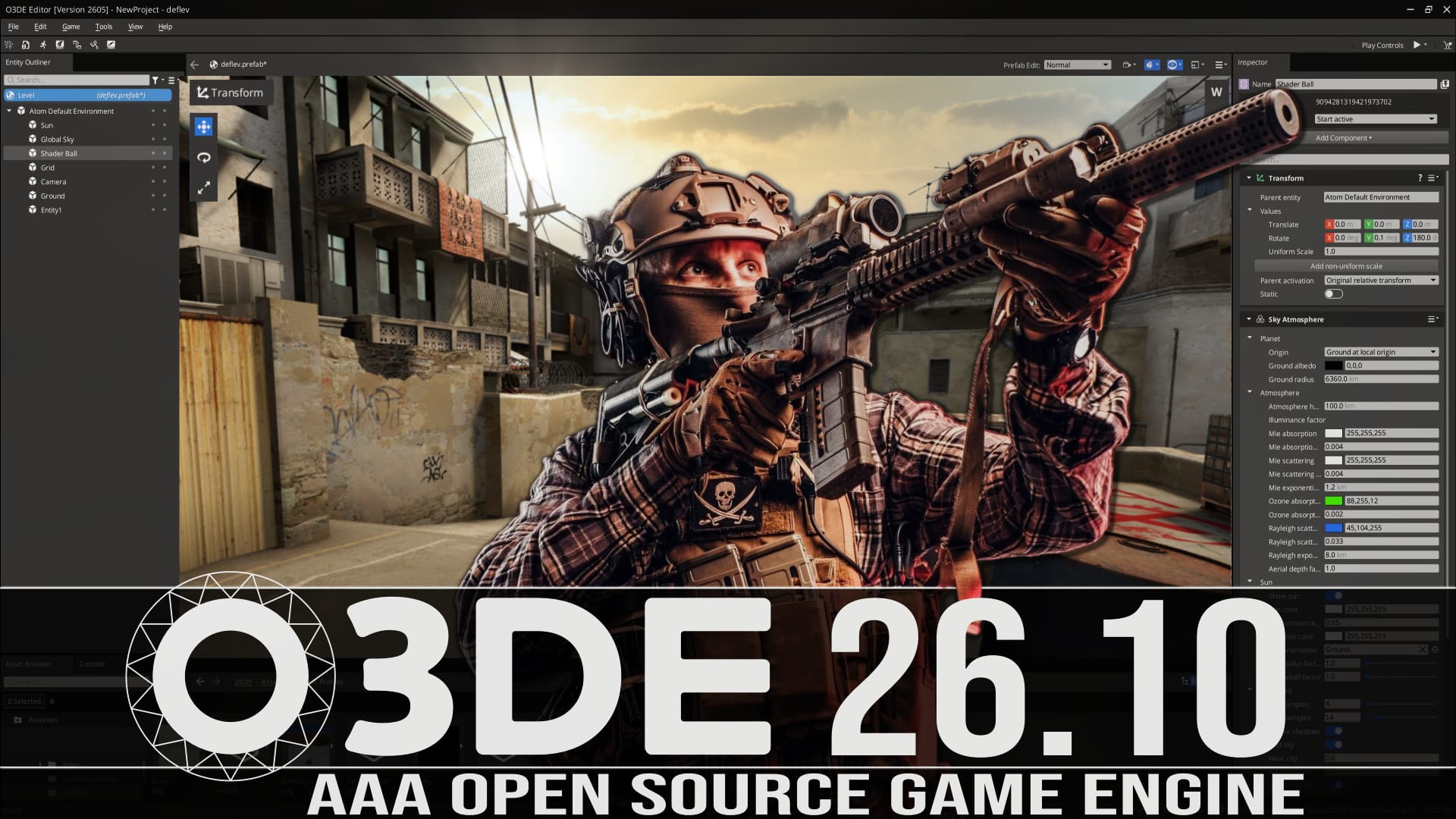
O3DE 26.10 has been released, with an Editor rebuilt on Qt 6.10.2, experimental native Mac ARM64 builds, GTAO and the final removal of PhysX 4. It also adds ROS 2 Lyrical Luth support and a cleaner, more standard core.
gamefromscratch.com10h ago3 min read
Control Resonant creative director talks dev decisions on Game Developer podcast
Game Developer's podcast this week features Control Resonant creative director Mikael Kasurinen discussing the difficult development decisions behind the game. Game Developer says the game sold over a million copies in two weeks.
gamedeveloper.com4d ago2 min read
