AMD adds RT-MLAS Vulkan extension for mid-level acceleration structures
AMD has released RT-MLAS, a provisional Vulkan extension that adds reusable mid-level acceleration structures between BLAS and TLAS. It aims to cut acceleration structure size and rebuild time in large, repetitive or animated scenes.
Digital Developer Desk, 16h ago, 3 min read
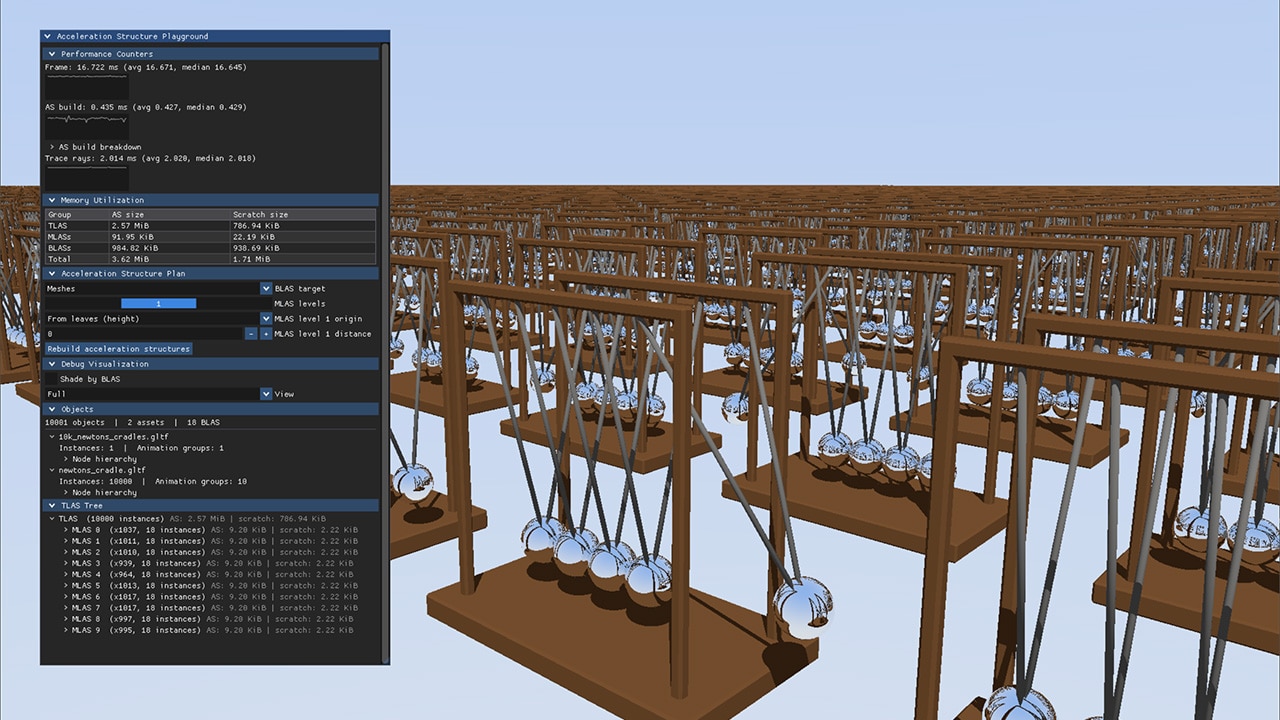
AMD has introduced Ray Tracing Multi-Level Acceleration Structures (RT-MLAS), a driver extension meant to reduce the size and rebuild time of ray tracing acceleration structures. It is available now as the provisional Vulkan extension VK_AMDX_multi_level_acceleration_structure on AMD Radeon RX 9000 Series GPUs and AMD Radeon AI PRO R9700 and R9600 Series GPUs. It ships in AMD Software: Adrenalin Edition 26.20.25.01 for Expanded Vulkan Extension Support. AMD says it plans to add DirectX 12 support in the future.
RT-MLAS is an AMD-exclusive extension that adds Mid-Level Acceleration Structures (MDLAS). An MDLAS holds instances of bottom-level acceleration structures (BLASs) and of other MDLASs, and it can be instanced inside a top-level acceleration structure (TLAS). That allows up to two new levels of hierarchy. AMD says an MDLAS is built much like a TLAS, and that the extension can be seen as allowing TLAS nesting, though it is not implemented exactly that way.
AMD's example is a neighborhood of houses built from shared walls, doors, windows and roof pieces. A BLAS per component keeps BLAS memory low but makes the TLAS large and slow to rebuild. A BLAS per unique house keeps the TLAS small but bakes in repeated components and uses more memory. With RT-MLAS, each unique house becomes an MDLAS that instances its components, and the TLAS instances those MDLASs.
AMD also released the Acceleration Structure Playground demo app, which loads a glTF scene and lets users add MDLASs at different levels of the scene hierarchy. The app needs glTF files modified beyond the v2.0 standard to supply a reusable hierarchy, and its readme has details. In AMD's demo scene of 10,000 rigidly animated Newton's cradles with 10 animation offsets, RT-MLAS used 3.62 MiB and had a 0.43 ms median rebuild time. A BLAS per component used 47.17 MiB and 0.97 ms, and a BLAS per unique cradle used 11.55 MiB and 1.60 ms. AMD ran the tests in November 2026 on a Ryzen 7 5800X, a Radeon RX 9070 and 32 GB RAM under Windows 11 Pro.
AMD notes there is currently some ray tracing overhead from tracking the extra hierarchy levels. The crossover point where RT-MLAS pays off is typically in more complex scenes, such as those using tetrahedral cage animation, where objects can consist of hundreds to thousands of BLASs and objects animated the same way can share an MDLAS. AMD also compares RT-MLAS with partitioned TLAS (P-TLAS). It says P-TLAS can give better traversal performance when partitions are unique and untransformed. MDLAS allows independent memory allocations, per-partition build-or-refit decisions, nested ray transforms and reuse of animated transformation hierarchies. AMD Fellow Holger Gruen also presented RT-MLAS at Graphics Programming Conference 2026.
Sources
Get the daily brief
The five stories that matter, every weekday morning. Free.
Everstone Studio details its DLSS 5 integration in Where Winds Meet
In a Q&A on the NVIDIA Technical Blog, Everstone Studio describes how it evaluated DLSS 5 in Where Winds Meet and says it adds performance overhead that developers should budget for early.
developer.nvidia.com9h ago3 min read

Unity CLI now connects coding agents to the Asset Store and 60+ AI generators
Unity announced that its CLI lets coding agents such as Claude Code and Codex search and download Asset Store content and generate assets with AI models. Asset Store and AI Generators access in the CLI are both in open beta.
unity.com9h ago3 min read
Unity previews URP upgrades for Unity 6.7 and Unity 7, releases Atrio sample
At Unite Tokyo, Unity showed upcoming Universal Render Pipeline features planned for Unity 6.7 and Unity 7, including Surface Cache GI, screen space reflections and new upscaler support. A new URP sample project, Atrio, shows the features.
gamefromscratch.com16h ago3 min read